
An Archaeology of Cotton
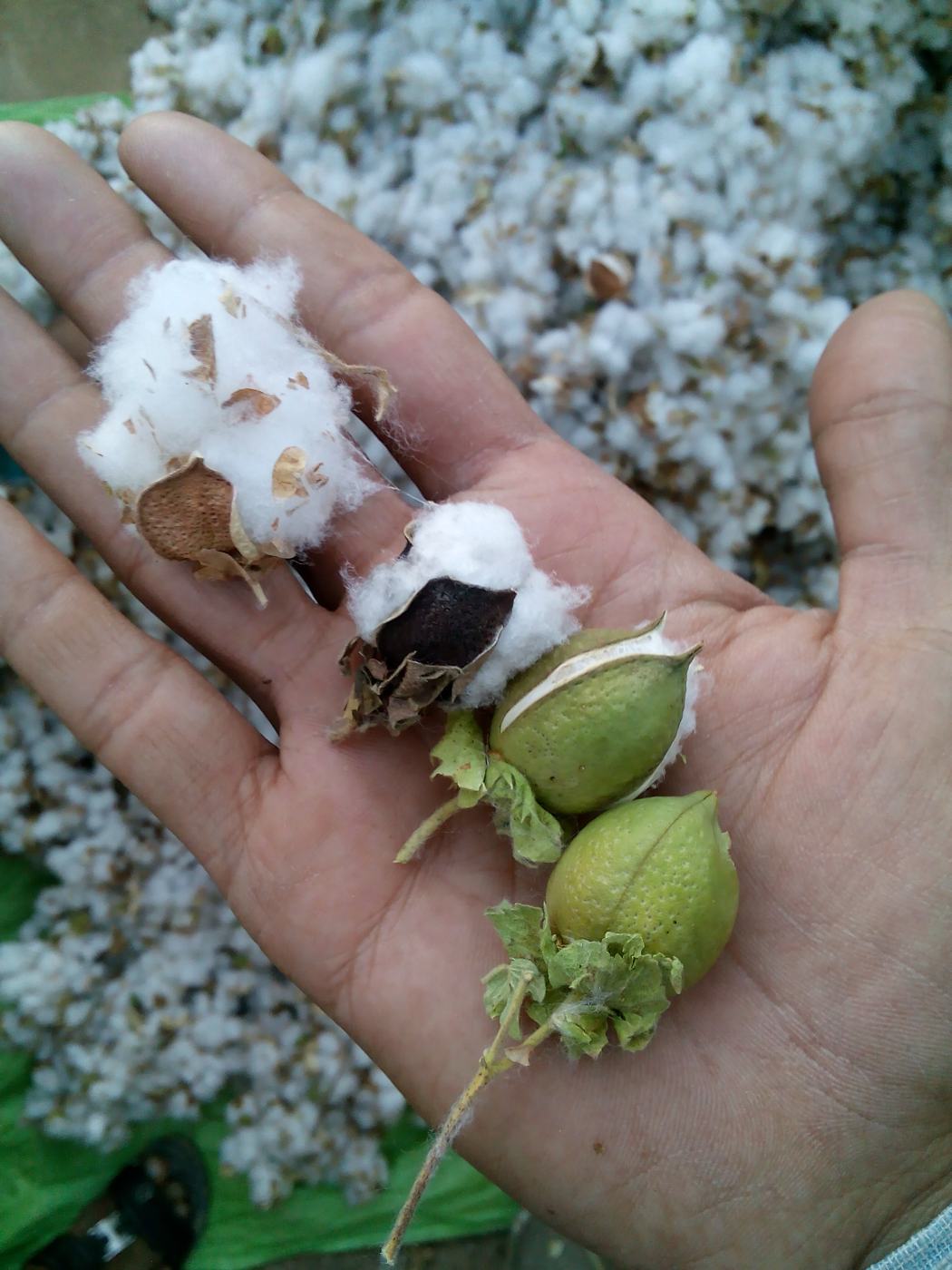
Until the middle of the 18th century, only the indigenous Arboreum and Herbaceum varieties of cotton, known as old world cotton, were grown in India. Archaeological evidence shows that cotton samples from Mohenjodaro, from around 3000 BC, were old world types. Texts as old as the Rigveda suggest that we knew how to make fine fabric from it.
During the colonial period, hybridisation with new world cotton spread to suit the mills of Britain and later India, and the old techniques fell out of mainstream practice.
What is Kala cotton?
Kala (pronounced kah-lah) cotton is an old world cotton of the type G. herbaceum. It has a short to medium staple and a closed or semi-open boll that is picked along with its calyx (thaliya). It is suited to rain-fed cultivation and grown mainly in the Rapar and Bhachau blocks of Kutch and the Patdi, Dasada and Mandal blocks of Surendranagar.
Why Kala cotton?
Pure. No inter-specific hybridisation or genetic modification has been used on Kala cotton, which makes it genetically very pure. Most cotton grown in India today is hybrid or Bt cotton.
Water efficient. It grows on rain alone, even in drought-prone areas with less than 40 cm of rainfall. Hybrid/Bt cotton needs about 1,400 litres of irrigation water per kilogram of seed cotton.
Low greenhouse gas emissions. Grown without irrigation, chemical fertilisers or pesticides, Kala cotton produces 109 g of CO₂ equivalent per kilogram of seed cotton, against 628 g for hybrid/Bt cotton.
Its low inputs also mean low risk for small farmers, who cannot absorb the high-stakes failures that come with input-heavy cotton.
Our part
Our initiative brings together farmers, hand spinners, dyers, weavers, designers and users to create products that celebrate local economies. Today 60 weaver families in 15 villages work with Kutch ji Chhap and earn their livelihood from it.